Prompt
A view of a star trail in the night sky.
VBench40.33 dB
Partition the Support. Reconstruct the Residual.
Texas A&M University
See the result
Image-to-world · native 720p class
Image-to-world · 720p
Text-to-video · 720p
Image-to-video · native aspect ratio
Abstract
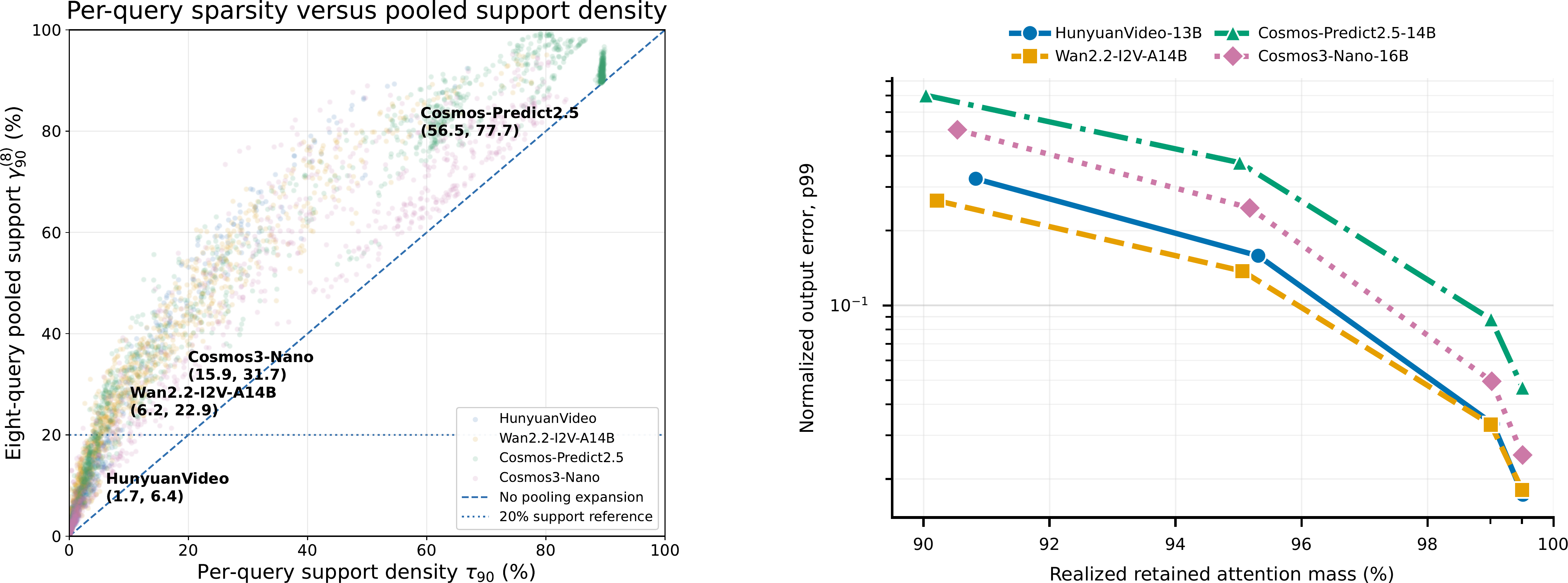
Training-free block-sparse attention can accelerate video transformers, but attention concentration alone does not define an executable sparse operator. Shared query routes can expand support, and retained attention mass does not predict the output error from skipped interactions.
SparsePR combines Response-Coupled Partitioning with Probe-Fitted Residual Reconstruction. It groups queries and paired K/V tokens by current-call responses, then uses a small set of exact query rows to correct the sparse output. Across four models, SparsePR preserves quality at 22% to 26% executed-pair density with 1.48× to 2.61× end-to-end speedups.
Why partition geometry matters
Support density is the percentage of key tokens needed to retain 90% of attention mass. The pooled diagnostic measures their union across queries before block routing.
One query needs a small key support.
Each query is sparse; a shared route must cover their union.
Method
SparsePR constructs the executable partition and reconstructs its error using features from the same current attention call.
Probe a compact subset of queries against K/V.
Form paired K/V groups, then response-aligned query groups.
Select and evaluate hardware-ready query–K/V cells.
Fit a call-specific correction from exact probe rows.
Sampled query responses define value-aware paired K/V groups. Their centroids become query-response coordinates, aligning queries that can efficiently share one route.
A small stratified set of query rows is evaluated exactly. Their observed post-softmax residuals fit an affine correction in a low-rank probe-residual subspace.
Results
All quantitative results from the final draft. Values use matched hardware and sequence shapes where reproduced. Density includes routing and exact probe pairs.
Table 1
| Model | Method | PSNR ↑ | SSIM ↑ | LPIPS ↓ | ImgQual ↑ | SubCons ↑ | PBench ↑ | Density ↓ | PFLOPs ↓ | E2E ↑ |
|---|---|---|---|---|---|---|---|---|---|---|
| HunyuanVideo-13B | Dense | – | – | – | 0.850 | 0.976 | – | 100.0% | 612.38 | 1.00× |
| HunyuanVideo-13B | SpargeAttn† | 25.31 | 0.832 | 0.217 | 0.763 | 0.928 | – | 40.19% | 389.76 | 1.38× |
| HunyuanVideo-13B | SVG2† | 29.87 | 0.907 | 0.121 | 0.850 | 0.927 | – | 25.45% | 299.02 | 2.30× |
| HunyuanVideo-13B | SVOO† | 24.87 | 0.843 | 0.224 | 0.679 | 0.976 | – | 33.26% | 345.81 | 2.17× |
| HunyuanVideo-13B | SVG-EAR† | 30.54 | 0.918 | 0.098 | 0.845 | 0.903 | – | 22.17% | 281.86 | 1.93× |
| HunyuanVideo-13B | SparsePR | 31.84 | 0.932 | 0.087 | 0.850 | 0.976 | – | 21.92% | 255.95 | 2.61× |
| Wan2.2-I2V-A14B | Dense | – | – | – | 0.689 | 0.974 | – | 100.0% | 658.46 | 1.00× |
| Wan2.2-I2V-A14B | SpargeAttn† | 26.74 | 0.871 | 0.116 | 0.680 | 0.953 | – | 30.15% | 396.83 | 1.58× |
| Wan2.2-I2V-A14B | SVG2† | 28.18 | 0.878 | 0.105 | 0.668 | 0.970 | – | 31.28% | 393.95 | 1.59× |
| Wan2.2-I2V-A14B | SVOO† | 29.67 | 0.913 | 0.095 | 0.689 | 0.973 | – | 31.67% | 389.62 | 1.61× |
| Wan2.2-I2V-A14B | SVG-EAR† | 29.75 | 0.921 | 0.086 | 0.680 | 0.970 | – | 23.64% | 378.88 | 1.61× |
| Wan2.2-I2V-A14B | SparsePR | 30.66 | 0.907 | 0.044 | 0.687 | 0.973 | – | 21.97% | 336.55 | 1.80× |
| Cosmos-Predict2.5-14B | Dense | – | – | – | 0.714 | 0.976 | 77.76 | 100.0% | 526.87 | 1.00× |
| Cosmos-Predict2.5-14B | SVG2 | 20.07 | 0.624 | 0.330 | 0.678 | 0.896 | 76.14 | 28.81% | 286.51 | 1.24× |
| Cosmos-Predict2.5-14B | SVOO | 22.06 | 0.685 | 0.289 | 0.701 | 0.909 | 76.03 | 37.63% | 315.38 | 1.03× |
| Cosmos-Predict2.5-14B | SVG-EAR | 25.54 | 0.908 | 0.062 | 0.710 | 0.976 | 77.76 | 29.75% | 289.69 | 1.10× |
| Cosmos-Predict2.5-14B | SparsePR | 26.33 | 0.942 | 0.068 | 0.714 | 0.976 | 77.75 | 22.14% | 253.61 | 1.51× |
| Cosmos3-Nano-16B | Dense | – | – | – | 0.700 | 0.950 | 77.31 | 100.0% | 127.61 | 1.00× |
| Cosmos3-Nano-16B | SVG2 | 22.45 | 0.735 | 0.216 | 0.677 | 0.915 | 75.03 | 37.29% | 96.19 | 1.16× |
| Cosmos3-Nano-16B | SVOO | 16.64 | 0.573 | 0.381 | 0.707 | 0.962 | 77.59 | 67.32% | 108.01 | 1.02× |
| Cosmos3-Nano-16B | SVG-EAR | 21.16 | 0.709 | 0.261 | 0.658 | 0.872 | 72.85 | 37.18% | 96.14 | 1.10× |
| Cosmos3-Nano-16B | SparsePR | 24.42 | 0.801 | 0.176 | 0.699 | 0.949 | 77.30 | 25.96% | 81.79 | 1.48× |
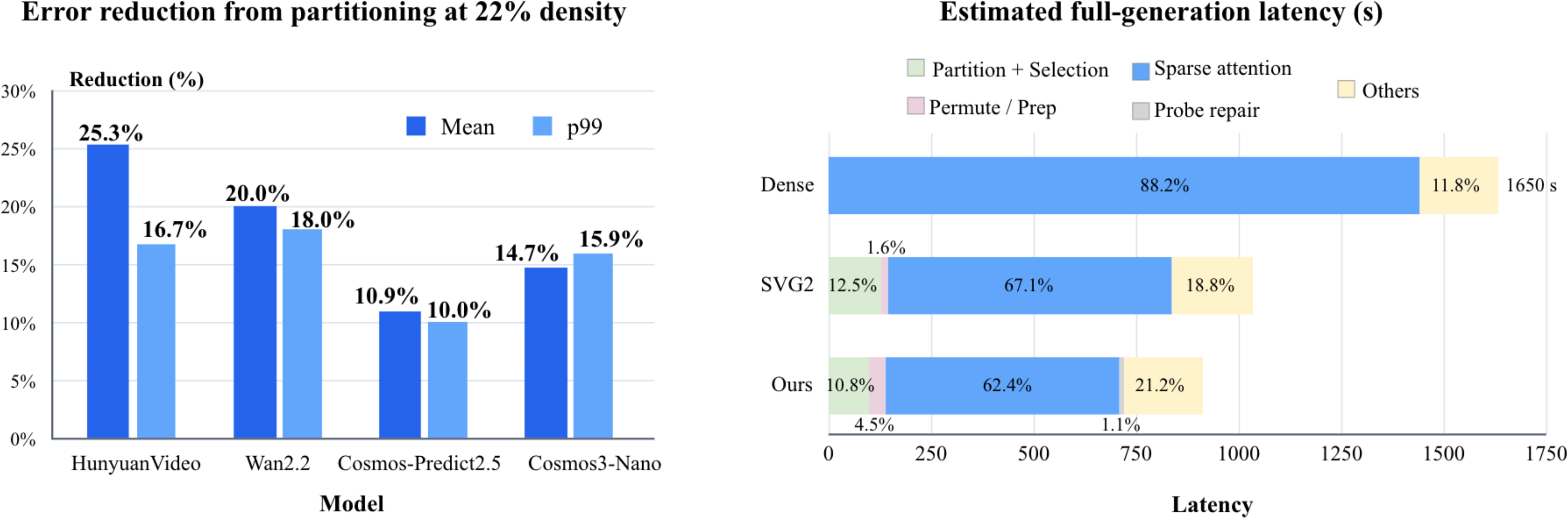
Table 2
| Configuration | HunyuanVideo | Wan2.2 | Cosmos-Predict2.5 | Cosmos3-Nano |
|---|---|---|---|---|
| Semantic partition | 0.089 / 0.714 | 0.164 / 1.734 | 0.791 / 7.532 | 0.359 / 3.356 |
| Key-response K/V partition | 0.085 / 0.812 | 0.156 / 1.659 | 0.769 / 7.270 | 0.341 / 3.174 |
| Response-coupled partition | 0.073 / 0.696 | 0.108 / 0.647 | 0.761 / 7.227 | 0.331 / 3.150 |
| Semantic + probe repair | 0.053 / 0.356 | 0.105 / 0.819 | 0.262 / 0.826 | 0.124 / 0.668 |
| SparsePR | 0.030 / 0.207 | 0.063 / 0.323 | 0.075 / 0.489 | 0.076 / 0.447 |
Citation
@article{taghavi2026partition,
  title={Partition the Support, Reconstruct the Residual: Training-Free Sparse Attention for Video Generation and World Models},
  author={Taghavi, Pardis and Langari, Reza and Pandey, Gaurav},
  journal={arXiv preprint arXiv:2608.18484},
  year={2026}
}