Response-Coupled Partitioning
Sampled query responses define value-aware paired K/V groups. Their centroids provide response coordinates for aligning queries that can efficiently share an executable route.
SparsePR method
SparsePR builds hardware-ready sparse routes and repairs their output error using information from the same attention call.
Evaluate a compact set of query rows exactly against K/V.
Form paired K/V groups and response-aligned query groups.
Select and evaluate hardware-ready query-to-K/V cells.
Fit a call-specific correction from the exact probe rows.
Sampled query responses define value-aware paired K/V groups. Their centroids provide response coordinates for aligning queries that can efficiently share an executable route.
A stratified set of exact query rows exposes the post-softmax residual. SparsePR fits an affine correction in a low-rank probe-residual subspace without updating model parameters.
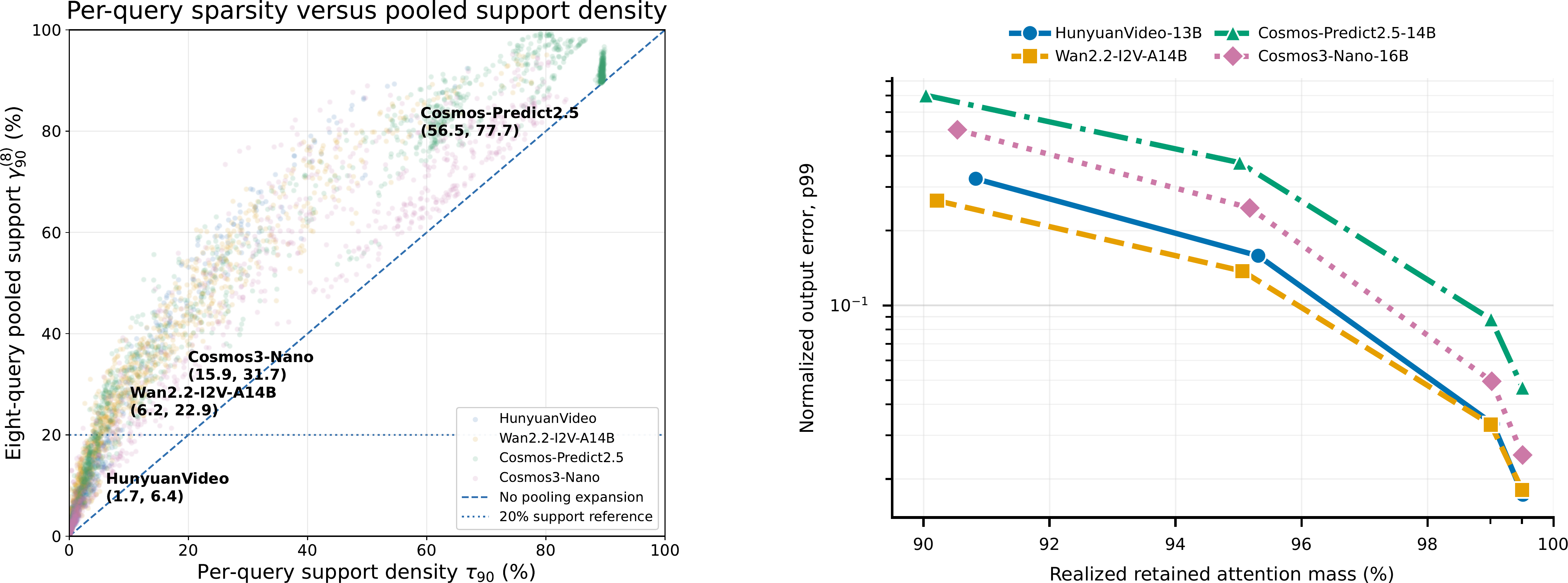
Queries that share one route must use the union of their K/V supports. SparsePR groups queries by response similarity to increase support overlap before routing.